Tuesday, June 4, 2013

Research Around the World

For this blog assignment I reviewed the Early Childhood Australia website.


http://www.earlychildhoodaustralia.org.au

I found that as I reviewed the site there were two main areas to access research. 

The first was a link to information about Australia Journal of Early Childhood which focuses on


http://www.earlychildhoodaustralia.org.au/australian_journal_of_early_childhood.html


Early childhood research, innovation and development

The Australasian Journal of Early Childhood (AJEC) is Australasia's foremost scholarly journal and the world's longest-running major journal within the early childhood field.

As I reviewed the abstracts of research article that have been published in this journal I ran across an approach I was not familiar with, the Mosaic Approach.  I found the abstract very interesting and am looking forward learning more about this intriguing topic related to research and young children.  The abstract is as follows:


Personal reflection on research process and tools: Effectiveness, highlights and challenges in using the Mosaic Approach
Personal reflection on research process and tools:
Effectiveness, highlights and challenges in using the Mosaic Approach
Cheryl Greenfield
Manukau Institute of Technology
THIS REFLECTION ON USING the Mosaic Approach as a framework for undertaking research with young children contributes to the dialogue around qualitative research methodology. The provocation of social constructivist theory challenges researchers to consider and explore innovative ways to position themselves so the multiple voices of children can be heard, valued, respected and listened to. Three underpinning principles are identified and each of the methodological tools used by Greenfield (2007a) is discussed. Trustworthiness or situated validity in research is vital. It is argued that the Mosaic Approach provides an effective, flexible and authentic methodology when undertaking research with young children.
Australasian Journal of Early Childhood – Volume 36 No 3 September 2011


The other link related to research was called Research in Practice.  This area of the website contained an index of a series books on research based early childhood practices.


http://www.earlychildhoodaustralia.org.au/research_in_practice_series.html

Research in Practice Series


For practical, effective approaches from early childhood experts and practitioners ...
The Research in Practice Series provides practical, easy-to-read resources for those involved in the early childhood field.
The books are designed to assist with those challenging issues which arise in the care and education of young children, by offering effective, new approaches.

Both the Journal articles and books reflected many of the same topics you might find on a similar website in the US however this website was incredibly user friendly and it was difficult for me to break away.  I found research on... 

  • Play
  • Strength Based Teaching
  • Reflection
  • Leadership
  • Diversity
  • Individualization
  • Policy Reform
To name just a few...

There were also many articles discussing the Australian National Quality Framework which seems to be a national early childhood system.  As someone who believes the US would benefit from such a system I look forward to reading more about the successes and challenges Australia has had with their system as I advocate for a comprehensive early childhood system in the US.  This chance to investigate a new resource was very worth my time.

Thursday, May 23, 2013

Research that will make a difference!

Dear Colleagues,

     I am going to reach on this assignment and share the Executive Summary of the NAEYC National Dialogue Phase I and II.  This is a process and ultimately a research study I have been deeply involved with since it's beginning in Anaheim, CA in November of 2010.  The executive summary explains as concisely as possible, 2 years of information gathering as well as the conclusions and recommendations made based on the obtained data. Upon implementation of the recommendations, NAEYC will become a more nimble, high preforming organization, prepared to lead our field into the future.   I truly believe this process and the transition within NAEYC that must occur based on the research findings will have a major lasting positive effect on our field and the children and families with whom we work.

For the Children,

Betsy Carlin
NAEYC Affiliate Council Past Chair

PS Unfortunately the embedded links do not work as they are password protected.  If you are a member of NAEYC you can access any of the described documents in the members area of the NAEYC website.


NAEYC Executive Summary: Revised National Dialogue Recommendations 


Purpose of the National Dialogue

The NAEYC Governing Board (GB) initiated a National Dialogue to strengthen the relationships among and between all component (Affiliate) parts of the Association: local, state, regional, and national. It charged the Affiliate Council (AC) with the oversight of this critically important work. Three recommendations emerged from the National Dialogue themes; 1) mission, 2) structural relationship, and 3) member voice.

Navigating the Executive Summary

Throughout the Executive Summary links are inserted directing the reader to key guiding documents describing the principles and decision-making process agreed to jointly by the NAEYC Governing Board and the Affiliate Council. Reading the White Paper may be particularly helpful to those who are relatively new to the National Dialogue. The reader can access each of the three recommendations in their entirety; including sections on evidence and rationale, impact grids that address implications for sustainability, infrastructure, and fiscal requirements online, or by following the link in each recommendation outlined in brief below. A complete archive of National Dialogue meetings, documents, and updates can be found in the Affiliate Resource Center. The Affiliate Council responses to recommendations are included in this summary with the full AC approval report also available online.

Phase I and Phase II of the National Dialogue

In Phase I of this initiative, which took place between January 2010 and June 2012, 4 national and 11 regional dialogues were conducted. Phase II began in July 2012 with the appointment of AC members to the AC Subcommittee. Their charge was to draft recommendations for review by the AC and GB, accompanied by a rationale and justification for the recommendations gleaned from the culminating results of nationally and regionally convened dialogues. By design, recommendations are to be viewed through the jointly approved Guiding Principles, Evaluative Lens and Decision-Making Criteria, and HPIO (high-performing, inclusive organizations) documents.

The GB received and accepted each of the recommendations as approved by the AC and the GB Subcommittees at their January 2013 board meeting in Washington, DC. They acknowledged the work of the Affiliate Council, the Subcommittees, staff and all involved in developing these recommendations which are seen as three core and critically important issues facing the Association. The GB envisions a process (Phase III) that will include a work plan, timeline, and the need to gather and review additional data with stakeholder input. Implementation of Phase III will position the Association as a stronger and more viable organization and must:
Recognize the interdependent nature of the relationship among and between components Achieve the ultimate goal of strengthening the relationship across components
Recognize that all stakeholders are necessary to address each of the recommendations
Identify both policy and operational implications
Affirm the Association’s commitment to HPIO, high performing and inclusive organizations Continue work in collaboration using The Guiding Principles and Decision Making Criteria

Phase III begins with Affiliate leadership (volunteer and staff) reviewing the approved recommendations along with an invitation post their comments online during a 15 day window beginning Monday, February 11th. Members are afforded the same opportunity beginning February 18th. All comments will be summarized and sent initially to the GB and AC before they are posted online. Your contributions are not only valued, but necessary as the collaborative nature of this organizational work studies the impact of each recommendation through additional data. The GB is committed to the National Dialogue process moving forward.

The National Dialogue Recommendations

Mission

Introduction
The AC Subcommittee wrestled with the concept of whether the Association should have a child or professional focus versus a child and professional focus. After much discussion and data-review of the evidence, the AC Subcommittee determined that the focus should be on both the professional and the child. In support of the AC Subcommittee’s second recommendation to the GB, the AC Subcommittee further agreed that it was essential to develop guidelines to support the Association’s network components in reviewing and reworking their mission statements to ensure all components’ missions were aligned with the mission of the national component. Specific phrasing should be crafted for network components to choose from.
  1. The Association’s mission statement should be reviewed by the NAEYC Governing Board and potentially revised.
  2. Should the NAEYC Governing Board decide to revise the Association’s mission statement, then the local, state, and regional components should review and potentially revise their respective mission statements to be in alignment with the national component and in accordance with any forthcoming guidelines by the NAEYC Governing Board. Read the full 9 page recommendation.
Affiliate Council Response
The process for soliciting feedback and approval from the AC and Affiliate Council Executive Committee (ACEC) was implemented in accordance with the AC Subcommittee Charge. All comments were considered, and it was determined that no modifications to the recommendations were required. The AC and the ACEC approved the recommendations as written by a unanimous vote. Council members comments are reflected in the following; “It is appropriate that all affiliate’s mission align for strength and unity of the Association. It is also important that we not only support children, but as an organization that is comprised of individuals and relies on them for support, that we include those professionals in our Association’s mission statement”, and “If the Governing Board decides to review the mission.....I encourage NAEYC to include members of local affiliates, senior staff, AC members as each has a unique, valued, and invested perspective of what the mission is of NAEYC”. Read the full report here.

Governing Board Response

The GB received the mission recommendation as approved by the AC at their January 2013 board meeting in Washington, DC identifying it as one of the core issues facing this Association.
Structural Relationship
Introduction
These structural relationship recommendations are built on the foundation of the AC Subcommittee’s first recommendation, which called for a review and potential change of the Association’s mission statement. These recommendations address the structural relationship among and between components and are designed to: 1) reconfigure the way in which components affiliate with the national component, 2) simplify the responsibilities of local components, 3) set the stage for more effective services to members, and 4) recognize the unique role of city-states within the Association.
Fundamental change is at the heart of these recommendations regarding the structural relationship— specifically between the local and national components. This change would significantly impact the relationship between the local and state components and address the consistent theme revealed throughout the National Dialogue meetings: Locals struggle with the non-profit business requirements in the current Affiliation model.
These recommendations are based upon the findings from Regional and National Dialogue meetings, component leadership surveys; the results of Program Alignment; and documented, effective practices of other non-profit membership associations. In addition to the recommendations presented, the AC Subcommittee recommends further research and dialogue regarding several specific points found in these recommendations.

Structural Relationship Recommendations
  1. The structure among and between components should be revised in a manner that simplifies, clarifies, and strengthens relationships. This structure must acknowledge that all components share members and must also support members. The intent is to have fewer components directly affiliated with the national component.
  2. The national component remains the standard bearer for the early childhood profession, leading national advocacy efforts and setting standards for programs and professional practices. All components serve members by reaching out to professionals in the field—providing professional development opportunities, sharing resources on best practices, and creating networks or communities of practice. State and local components are more able to “touch” the member directly while leading local advocacy efforts. Read the full 14 page recommendation.
Affiliate Council Response

The AC voted to approve this recommendation (49 approved, 1 do not approve). Council member responses reflected concerns with fiscal implications for all components, and additionally needed supports for all volunteer state component boards. An ongoing concern for those local components who may feel disconnected; “ We would not want to experience the unintended consequence for those very committed local affiliate Board members to pull back from the association if they even think ‘they don't count’ as much. Enhanced clarity and reassurance around their continued role to do what they do best, at a local level, such as providing professional development opportunities access to resources, ‘touching’ the members locally, and building upon what NAEYC and the states have to offer would be helpful as this material moves forward”. Read the full report here.

Governing Board Response

The GB received the structural relationship recommendation as approved by the AC at their January 2013 board meeting in Washington, DC identifying it as one of the core issues facing this Association.

Member Voice

Readers Note:
There are no policy implications inherent in this recommendation as it addresses the
operational side of member outreach and engagement.

Introduction
The national component remains the standard bearer for the early childhood profession, leading national advocacy efforts and setting standards for programs and professional practices. All components share the responsibility to serve members through outreach and engagement efforts to professionals in the field, providing professional development opportunities, sharing resources on best practices, and creating networks or communities of practice. State and local components are more able to “touch” the member directly while leading local advocacy efforts. The intent of this recommendation is to create multiple ways to recognize shared members’ areas of expertise, and to increase the opportunity for their active engagement and influence throughout this Association.
  1. The programs and services of the Association need to be aligned with its mission and the AC Subcommittee offers the member voice recommendation with the assumption that the mission statement will be revised to include the early childhood professional.
  2. Member expertise should be leveraged; Interest Forums are a good example.
  3. Given the shared nature of membership, all components should collaborate to identify issues and priorities as seen from the member perspective.
  4. Components should consider how member voice relates to choice and the value of member benefits.
  5. All components should consider cost- and revenue-sharing opportunities when offering products and services.
  6. All components should provide opportunities for member engagement through easily accessible mechanisms and personal contact when possible.
  7. All components should have the necessary tools and processes to gather information from members—including member preference regarding how their voice can influence their Association.
  1. All components should have a timely process in place to respond to a member’s interest in engagement.
  2. All components should offer experiences that allow volunteers a variety of time- commitment opportunities (for example, one-time involvement, committee work, advocacy, board position, etc.) to engage members. Read the full 10 page report.
Affiliate Council Response

The AC voted to approve this recommendation (42 approved, 1 abstention.)Council member responses reflected potential fiscal implications with a specific focus on technology needs, and the importance of coordinating efforts and resources across components. One Council member summarized the thoughts of many; “If approved by the Governing Board the success of recommendation three will hinge on a strong implementation plan. The plan will need to foster a climate of continuous improvement through ongoing evaluation of implementation at all component levels, mutual support and communication”. Read the full report here.

Governing Board Response

The GB received the member voice recommendation as approved by the AC at their January 2013 board meeting in Washington, DC identifying it as one of the core issues facing this Association.
Conclusion
The National Dialogue was initiated to strengthen the relationship among and between the Association component parts. Phase I and II are completed with the GB receiving each of the recommendations; mission, structural relationship between and among Association components, and member voice. The GB recognizes the importance of continuing to engage in the National Dialogue by engaging Association leadership in a collaborative process that will identify additional, necessary data to determine the final outcome and implementation of each recommendation.
Phase III begins with the publication of this Executive Summary and the National Dialogue Recommendations as approved by the AC and received by the GB. Leadership and members have the opportunity to contribute their comments, questions, and suggestions in an online comment period. Timelines, communication plans, and an implementation process for Phase III will begin by early March of 2013. This is truly an important opportunity to create an Association that is nimble enough to face the future, effective enough to engage and grow membership, and with enough commitment to honor the principles of a high performing, inclusive organization.


NAEYC Affiliate and Member Relations February 2013. Posted 2.11.2013. Revised and Posted 2.12.2013.  Retrived from: 
http://www.naeyc.org/files/naeyc/Revised%20Final%20Executive%20Summary_GS_02122013.pdf


Saturday, May 18, 2013

Research Simulation Update


Franklin D. Roosevelt 


I feel passionately that relationships are the foundation to high quality education so I have decided to focus my research simulation on relationships.  

My original general topic:

The role of relationships in early childhood programs.

          “Research tells us that family-program relationships influence young children’s outcomes” (Lopez, 2010) and that the establishment of positive, personal relationships with children and families enhances children’s development and learning (Gallagher, & Mayer, 2008), but these relationships are time consuming, can be difficult to develop and are often lost among other program priorities.  As a former program director I have reflected on my strengths and have come to understand that my ability to develop relationships has been a major contributor to my professional success.   During my course work this personal understanding has been supported through professional articles and research.  I identified the three subtopics with the intent to establish the generalisability (Mac Naughton, Rolfe, & Siraj-Blatchford, 2010) of relationships in early childhood settings, to understand practices that help to institute program-family relationships and to begin to understand what skills and tools the early childhood workforce needs to create effective relationships in the classroom. 
            “Most teachers enter the early childhood profession because they enjoy being with children. They do not necessarily have an interest in children’s families, nor are they always prepared to work with them. The professional culture has promoted this mindset, emphasizing the child and paying less attention to family and community roles in child development. ” (Lopez, 2010).  By researching the importance of relationships in early childhood this mindset can be challenged, programs can refocus their attention to include the establishment of strong relationships with families, and effective professional development can be designed to help teachers to be more prepared to establish relationships with children and families. 

References
Gallagher, K. C., & Mayer, K. (2008). Enhancing development and learning through
teacher-child relationships. Young Children, 63(6), 80-88.
Retrieved from the Walden Library using the ProQuest Central database.

Lopez, M. (2010). Valuing families as partners. Retrieved from
Mac Naughton, G., Rolfe, S.A., & Siraj-Blatchford, I. (2010). Doing early childhood research:      
          International perspectives on theory and practice (2nd ed.). New York, NY: McGraw-Hill.

I have chosen the subtopic:

The effects of specific relationship training for early childhood professionals on child outcomes

So far I have found the research simulation fascinating and time consuming.  Because I have chosen a topic that really resonates with me I found the literature review to be great, however I found that I read more then 3 articles.  I am glad to be finishing up this week's assignments now so I can have a break before I start next week's work.

I am wondering how my colleagues are feeling?


Monday, April 22, 2013

Early Childhood Beyond Our Boarders


        When we look beyond our own boarders and reach out to others great things can happen.  This has never been more obvious to me since my exploration of the international early childhood field.  Until I entered into my Walden University program I had only thought about the field of early childhood beyond the United States minimally and in isolation.  It has been exciting to read about worldwide collaborations in the name of the well being of all children and families.

Consequences of learning about the international early childhood field are...


  • The ability to see how each country in the world is unique and the children and families have unique needs so they can thrive and how the field of early childhood meets those needs.
  • Becoming more culturally competent
  • To explore websites that share information and success stories in the name of early care and education.
  • To learn about the many collaborative groups from across the globe that are working to raise quality and provide access to early care and education for all.
  • Reading about National early care and education systems in other countries that are adequately funded and supported and creating equity and excellence for the children, families and the EC professionals. 
  • Becoming aware of the power we can have in the name of all young children of the world when we work together.  


The goal I would put forward for the international early childhood field is to build bridges across nations, share ideas, celebrate successes and work together "to promote inclusive, quality care and education experiences that create the conditions for every child to be happy and reach his or her full potential" (International Step by Step Association, 2013).

International Step by Step Association Website. (2013) retrieved from: http://www.issa.nl

Friday, April 19, 2013

International Contacts

        I did finally hear back from the school in Dangriga, Belize, however it was to say they had received my message and would be happy to communicate with me.  I quickly shot off an email with some questions that might start an interesting dialogue but have yet to hear back.

       Because I did not have much to report on my personal contact I visited the UNESCO website.  I decided to focus on what I would identify as their advocacy initiatives, Access and Equity, Quality, Investment and Financing, and Coordination and Integration.  As I read I found several ideas related to my professional goals and my future as an advocate.  I especially appreciated the identification of a separate category for Coordination.  

Coordination issues include coherent regulation, funding and staffing schemes and a common vision of care and education. Effective coordination must exist among sectors at both national and local level, and also between public and private establishments.

       As a past director of a corporate sponsored child care center I found the following statement to make sense.  I do believe and will advocate for a national early childhood system with an infrastructure that includes consistent funding streams, but with a multitiered delivery system that includes the private sector.  Strong early childhood programs are a major factor in the lives of employees of all businesses.  I believe businesses should be looked upon to help build the system.


In general, government funding for early childhood is extremely small. For this reason approaching the private sector (non-profit and for-profit) can be an effective strategy.

      One of my goals relates to completing my Master's degree.  I want to have more understanding and be able to articulate more clearly what I know from my years of experience.  The combination of education and experience along with some passion is what makes a great ECE professional.

The ECCE workforce is often made up of a diverse group of pre-school teachers, care workers, informal carers and other professionals. Adequate training and work conditions are essential so they can integrate the content and practice of early childhood care and education and address the transition to formal schooling.

      The following is the introduction of an attached article to the Quality page on the UNESCO website.  It is a great example of a government working so all children can have access to high quality early learning environments.  You might want to take a look at the entire document.

http://unesdoc.unesco.org/images/0013/001374/137413e.pdf


Inter-Ministerial Collaboration in Early Childhood Training in Singapore
Introduction
In Singapore, childcare centres and preschools come under the auspices of the Ministry of Community Development and Sports (MCDS) and the Ministry of Education (MOE), respectively. The two ministries developed separate and independent policies and administrative systems over the years. In 1999, they initiated inter-ministerial collaboration, including teacher training.
This brief discusses Singapore’s development of childcare services and preschool education, the factors that led to the inter-ministerial collaboration, the role of the Preschool Qualification Accreditation Committee (PQAC), the challenges faced and the outcomes of the collaboration. 


UNSCO Website. (2013) Retrieved from: http://www.unesco.org/new/en/education/themes/strengthening-education-systems/early-childhood/

Friday, April 12, 2013

Sharing Web Resources

Today I started by going back to the Step by Step website and digging a little deeper.  I began reading about a collaborative project in which Step by Step was involved called

Open Society Foundations and International Step-by-Step Association Launch the Romani Early Years Network


Upon further reading I saw a link to the website of one of the partner organizations Diversity in Early Childhood Education and Training http://www.decet.org/en.html because it sounded like I could gain some more insight on the equity issue of access for all.  I decided to explore the new website to see what they were about. What I found most exciting about the new website was the partnerships across Europe.  Often I think about our field as it is contained in one nation.  I find the joint work of so many Countries to be inspiring.  I also appreciate the work that is done in the spirit of the UN Convention on the Rights of the Child.  By finding and exploring this website and others like it will add a richness  to my knowledge and ultimately my work on behalf young children and their families.  Here is look at their work.

MISSION STATEMENT
All children and adults have the right to evolve and to develop in a context where there is equity and respect for diversity. Children, parents and educators have the right to good quality in early childhood education services, free from any form of - overt and covert, individual and structural - discrimination due to their race, colour, sex, language, religion, political or other opinion, national, ethnic or social origin, property, disability, birth or other status (in reference to Article 2, UN-Convention on the Rights of the Child).

Therefore the DECET Network will empower knowledge, skills and attitudes to enable children and adults to construct together early childhood education services and communities where everyone:
  • feels that he/she belongs
  • is empowered to develop the diverse aspects of his/her identity
  • can learn from each other across cultural and other boundaries
  • can participate as active citizens
  • actively addresses bias through open communication and willingness to grow
  • work together to challenge institutional forms of prejudice and discrimination
About Diversity in Early Childhood Education

DECET vzw (Diversity in Early Childhood Education and Training) brings together a network of European organisations and projects with common goals about valuing diversity in early childhood education and training.
The network aims at promoting and studying democratic child care, acknowledging the multiple (cultural and other) identities of children and families. We view early childhood provisions as meeting places where people can learn form each other across cultural and other borders and therefore as public provisions that can effectively address prejudices and discrimination. In this sense early childhood education makes a clear contribution to the construction of European citizenship.


DECET Goals

The European DECET Network promotes equity and celebrates diversity in early childhood education services and in training, in the spirit of the UN Convention on the Rights of the Child by:

1. Facilitating exchange among trainers, practitioners, researchers and policy makers throughout Europe
2. Actively and critically promoting accessibility and quality in early childhood education services, which includes equity and respect for diversity.
  • for cooperation with parents this means to empower them to fully participate in early childhood services and in their community as democratic citizens
  • for working with educators this means to address stereotypical thinking and institutional discrimination
  • for working with policy makers and managers this means to work towards equal access for children, parents and staff and challenging discrimination and unequal power relation in early childhood education services
3. Developing new insights and knowledge in this field
4. Working in collaboration with other networks in and outside Europe
5. Devising and implementing strategies to impact mainstream childcare services and influence current childcare policies

Diversity in Early Childhood Education and Training Website (2013) Retrieved from:http://www.decet.org/en/about-us.html

Friday, April 5, 2013

Experiences in Belize

      Two weeks ago I wrote about a podcast I had listened to about an educator in Belize, Delfena Mitchell.  I choose to listen to that particular podcast because I was about to embark on a trip to visit the country of Belize myself.  I had hoped to be able to visit a school while I was in Belize but like many United State's schools the children were out for Easter break.  I did have several experiences I think are worth sharing as my early childhood connection this week.

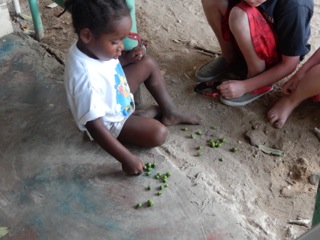
      During my trip I visited a cafe with my 7 year old daughter in the small village of Hopkins, Belize.  While there we began to observe a small child of 3 years.  This child was playing in the open air cafe while his mother worked.  He was expected to entertain himself.  As we were there he went to the back of the building to collect many green pods which he brought to us.  He also had brought one purple berry.  With these he began to show my daughter how to play marbles.  As I observed the interaction between the two children I realized he was speaking English to my daughter and the Belizean Creole which is spoken by most residents to his mother and other patrons of the cafe.  I later found out all Belizeans speak 2 to 3 languages from a very young age. 
I also watched him use the seeds to play and observed the excellent fine motor skills it took for him to play.  Both my daughter and I were very impressed by his creativeness and his ability to play.  At 7 years my daughter had a hard time getting the seed to shoot out of her fingers correctly.  My daughter continued to play with this young boy for the remainder of the afternoon.  As I continued to observe I remained amazed by this child's independence, tenacity and ability to play.


      I also visited a business owned by woman from Canada.  We were discussing her business and taxes in Belize.  She indicated she paid 14% taxes but none of it went to infrastructure.  She found it frustrating that although she was paying taxes the many roads continued to be unpaved or in disrepair etc.  What she found most frustrating was that women who worked for her had to pay to have their children attend school.  She felt her taxes should be supporting the people and systems in Belize.  

      Upon my return I have tried to make a contact with a preschool in Dangriga, Belize to establish a relationship and get more direct information on programs for young children in their country but I have not heard back as of today.  I then decided to do some research on my own about eduction in Belize on the internet.  Here are some of the facts about primary schools there.    


Tuition is USD$15 a month, though the government covers it for citizens and permanent residents.While public education is "free" for most children, parents still have to pay for school supplies, books and uniforms. These costs are occasionally too high for Belizean parents, which forces some students to drop out early Nearly every child is enrolled in the first year, yet only about 75 percent finish primary school. Recently, the government has begun programs to cut costs for parents, such as lending textbooks to all students for free. The programs, though still imperfect, should help to reduce dropout rates.

The availability and quality of public education varies greatly throughout Belize. Schools are generally better in major cities and towns, with the best selection in Belize City. Slightly less than 40 percent of Belizean teachers have formal training and class sizes hover between 17 and 23 students per teacher. The poorest school conditions are in Toledo, with the highest dropout rates in the country and the fewest trained teachers. Schools range from modern two story buildings with science and computer labs to single room shacks with thatched roofs. The Ministry of Education provides school buses for children with long distances between school and home, mostly in rural areas.
Paradise Hunter Website. (2013) Retrieved from: http://www.paradisehunter.com/CountryInformation/Belize/Living-There/Schools
      Upon further exploration I found a research paper written on the status of preschool in Belize.  It describes a movement in Belize to move quality early learning programs forward.  Below I am sharing several paragraphs form the papers conclusion.
"I am delighted that I took the opportunity to conduct this study that described the current status of preschool education in Belize. When I first explored the idea of this national study, I was a little uneasy about what I would find. I did not want to submit a report with all negative statements to describe the status of preschool education to my colleagues in Belize. As I conducted my observations, I was impressed by the efforts that were being made to provide access to young children and to improve the quality of preschool education in Belize.I was ecstatic.
 
The first program that impressed me was the attachment program that the government recently initiated. Attaching preschools to the public primary schools was a great way to provide access to young children especially those in the lower-income areas, the villages. The second program that astonished me was the preschool district coordinator program that commenced in September 2007. The major stakeholders did not simply decide to establish more preschool programs without support. Rather, they provided coordinators in each district to monitor and to assist teachers to develop the quality of their programs.

Getting deeper in the study with the observations and the interviews, I was amazed by the role and involvement of the National Preschool Unit to develop the quality of early childhood programs. The development of a standardized curriculum, standardized classroom routine schedule, and a standardized list of basic display chart and materials for each preschool classroom was impressive. This standardization was applied to all preschool classrooms around the country, rural, urban, public, and private, along with annual workshops. This was impressive and brought to my attention that this may have been the reason why the scores of the observation instruments did not differ in regard to area and type of preschool.

Then to top it off was the development of an associate degree pilot program in early childhood education that commenced in fall 2007. Although the program caters to a small group of early childhood education teachers concentrated in one district, it is a great step toward getting preschool teachers qualified. Increasing the number of teachers in the program and providing the program to the other five districts would be the next step to increase the rate of qualifying preschool teachers.

Although the quality of the preschool environments was scored in the minimal range due to the lack of financial resources and physical resources, these four positive initiatives will improved the quality of preschool education in Belize. With a conscious effort to promote and provide safe, healthy, and attractive learning environments for young children, the preschool education will continue to develop to the point that it can be compared with the standards and quality of preschool programs in other countries around the world. The process used might be applicable to developing countries in similar circumstances.

One major stakeholder emphasized, “I have seen a lot of improvements. And when I say a lot of improvements, I mean a lot of improvements because the teachers, the teachers  are  excited  and  I  am  excited ....” I must say  that  I too am extremely  excited about the direction of the progress and development of preschool education in Belize, and I can see why preschool stakeholders were excited about the program. The country has recognized the importance of preschool education and has embarked on initiatives to develop the program. It would be my honor to participate in this endeavor. This attention to early childhood education has the possibility to take Belize’s economy and social structure to the next level. This is certainly something to be excited about and to celebrate". 


August, A. L. (2012) Preschool Education in Belize: Research on the Current Status and Implications for the FutureCollege of Education & Human Services, University of North Florida, Jacksonville, 32224, USA 
Education 2012, 2(7): 231-238 DOI: 10.5923/j.edu.20120207.03