Friday, April 12, 2013

Sharing Web Resources

Today I started by going back to the Step by Step website and digging a little deeper.  I began reading about a collaborative project in which Step by Step was involved called

Open Society Foundations and International Step-by-Step Association Launch the Romani Early Years Network


Upon further reading I saw a link to the website of one of the partner organizations Diversity in Early Childhood Education and Training http://www.decet.org/en.html because it sounded like I could gain some more insight on the equity issue of access for all.  I decided to explore the new website to see what they were about. What I found most exciting about the new website was the partnerships across Europe.  Often I think about our field as it is contained in one nation.  I find the joint work of so many Countries to be inspiring.  I also appreciate the work that is done in the spirit of the UN Convention on the Rights of the Child.  By finding and exploring this website and others like it will add a richness  to my knowledge and ultimately my work on behalf young children and their families.  Here is look at their work.

MISSION STATEMENT
All children and adults have the right to evolve and to develop in a context where there is equity and respect for diversity. Children, parents and educators have the right to good quality in early childhood education services, free from any form of - overt and covert, individual and structural - discrimination due to their race, colour, sex, language, religion, political or other opinion, national, ethnic or social origin, property, disability, birth or other status (in reference to Article 2, UN-Convention on the Rights of the Child).

Therefore the DECET Network will empower knowledge, skills and attitudes to enable children and adults to construct together early childhood education services and communities where everyone:
  • feels that he/she belongs
  • is empowered to develop the diverse aspects of his/her identity
  • can learn from each other across cultural and other boundaries
  • can participate as active citizens
  • actively addresses bias through open communication and willingness to grow
  • work together to challenge institutional forms of prejudice and discrimination
About Diversity in Early Childhood Education

DECET vzw (Diversity in Early Childhood Education and Training) brings together a network of European organisations and projects with common goals about valuing diversity in early childhood education and training.
The network aims at promoting and studying democratic child care, acknowledging the multiple (cultural and other) identities of children and families. We view early childhood provisions as meeting places where people can learn form each other across cultural and other borders and therefore as public provisions that can effectively address prejudices and discrimination. In this sense early childhood education makes a clear contribution to the construction of European citizenship.


DECET Goals

The European DECET Network promotes equity and celebrates diversity in early childhood education services and in training, in the spirit of the UN Convention on the Rights of the Child by:

1. Facilitating exchange among trainers, practitioners, researchers and policy makers throughout Europe
2. Actively and critically promoting accessibility and quality in early childhood education services, which includes equity and respect for diversity.
  • for cooperation with parents this means to empower them to fully participate in early childhood services and in their community as democratic citizens
  • for working with educators this means to address stereotypical thinking and institutional discrimination
  • for working with policy makers and managers this means to work towards equal access for children, parents and staff and challenging discrimination and unequal power relation in early childhood education services
3. Developing new insights and knowledge in this field
4. Working in collaboration with other networks in and outside Europe
5. Devising and implementing strategies to impact mainstream childcare services and influence current childcare policies

Diversity in Early Childhood Education and Training Website (2013) Retrieved from:http://www.decet.org/en/about-us.html

Friday, April 5, 2013

Experiences in Belize

      Two weeks ago I wrote about a podcast I had listened to about an educator in Belize, Delfena Mitchell.  I choose to listen to that particular podcast because I was about to embark on a trip to visit the country of Belize myself.  I had hoped to be able to visit a school while I was in Belize but like many United State's schools the children were out for Easter break.  I did have several experiences I think are worth sharing as my early childhood connection this week.

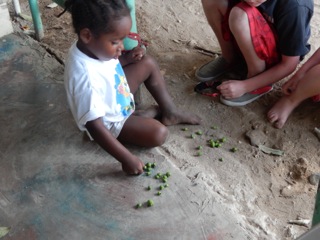
      During my trip I visited a cafe with my 7 year old daughter in the small village of Hopkins, Belize.  While there we began to observe a small child of 3 years.  This child was playing in the open air cafe while his mother worked.  He was expected to entertain himself.  As we were there he went to the back of the building to collect many green pods which he brought to us.  He also had brought one purple berry.  With these he began to show my daughter how to play marbles.  As I observed the interaction between the two children I realized he was speaking English to my daughter and the Belizean Creole which is spoken by most residents to his mother and other patrons of the cafe.  I later found out all Belizeans speak 2 to 3 languages from a very young age. 
I also watched him use the seeds to play and observed the excellent fine motor skills it took for him to play.  Both my daughter and I were very impressed by his creativeness and his ability to play.  At 7 years my daughter had a hard time getting the seed to shoot out of her fingers correctly.  My daughter continued to play with this young boy for the remainder of the afternoon.  As I continued to observe I remained amazed by this child's independence, tenacity and ability to play.


      I also visited a business owned by woman from Canada.  We were discussing her business and taxes in Belize.  She indicated she paid 14% taxes but none of it went to infrastructure.  She found it frustrating that although she was paying taxes the many roads continued to be unpaved or in disrepair etc.  What she found most frustrating was that women who worked for her had to pay to have their children attend school.  She felt her taxes should be supporting the people and systems in Belize.  

      Upon my return I have tried to make a contact with a preschool in Dangriga, Belize to establish a relationship and get more direct information on programs for young children in their country but I have not heard back as of today.  I then decided to do some research on my own about eduction in Belize on the internet.  Here are some of the facts about primary schools there.    


Tuition is USD$15 a month, though the government covers it for citizens and permanent residents.While public education is "free" for most children, parents still have to pay for school supplies, books and uniforms. These costs are occasionally too high for Belizean parents, which forces some students to drop out early Nearly every child is enrolled in the first year, yet only about 75 percent finish primary school. Recently, the government has begun programs to cut costs for parents, such as lending textbooks to all students for free. The programs, though still imperfect, should help to reduce dropout rates.

The availability and quality of public education varies greatly throughout Belize. Schools are generally better in major cities and towns, with the best selection in Belize City. Slightly less than 40 percent of Belizean teachers have formal training and class sizes hover between 17 and 23 students per teacher. The poorest school conditions are in Toledo, with the highest dropout rates in the country and the fewest trained teachers. Schools range from modern two story buildings with science and computer labs to single room shacks with thatched roofs. The Ministry of Education provides school buses for children with long distances between school and home, mostly in rural areas.
Paradise Hunter Website. (2013) Retrieved from: http://www.paradisehunter.com/CountryInformation/Belize/Living-There/Schools
      Upon further exploration I found a research paper written on the status of preschool in Belize.  It describes a movement in Belize to move quality early learning programs forward.  Below I am sharing several paragraphs form the papers conclusion.
"I am delighted that I took the opportunity to conduct this study that described the current status of preschool education in Belize. When I first explored the idea of this national study, I was a little uneasy about what I would find. I did not want to submit a report with all negative statements to describe the status of preschool education to my colleagues in Belize. As I conducted my observations, I was impressed by the efforts that were being made to provide access to young children and to improve the quality of preschool education in Belize.I was ecstatic.
 
The first program that impressed me was the attachment program that the government recently initiated. Attaching preschools to the public primary schools was a great way to provide access to young children especially those in the lower-income areas, the villages. The second program that astonished me was the preschool district coordinator program that commenced in September 2007. The major stakeholders did not simply decide to establish more preschool programs without support. Rather, they provided coordinators in each district to monitor and to assist teachers to develop the quality of their programs.

Getting deeper in the study with the observations and the interviews, I was amazed by the role and involvement of the National Preschool Unit to develop the quality of early childhood programs. The development of a standardized curriculum, standardized classroom routine schedule, and a standardized list of basic display chart and materials for each preschool classroom was impressive. This standardization was applied to all preschool classrooms around the country, rural, urban, public, and private, along with annual workshops. This was impressive and brought to my attention that this may have been the reason why the scores of the observation instruments did not differ in regard to area and type of preschool.

Then to top it off was the development of an associate degree pilot program in early childhood education that commenced in fall 2007. Although the program caters to a small group of early childhood education teachers concentrated in one district, it is a great step toward getting preschool teachers qualified. Increasing the number of teachers in the program and providing the program to the other five districts would be the next step to increase the rate of qualifying preschool teachers.

Although the quality of the preschool environments was scored in the minimal range due to the lack of financial resources and physical resources, these four positive initiatives will improved the quality of preschool education in Belize. With a conscious effort to promote and provide safe, healthy, and attractive learning environments for young children, the preschool education will continue to develop to the point that it can be compared with the standards and quality of preschool programs in other countries around the world. The process used might be applicable to developing countries in similar circumstances.

One major stakeholder emphasized, “I have seen a lot of improvements. And when I say a lot of improvements, I mean a lot of improvements because the teachers, the teachers  are  excited  and  I  am  excited ....” I must say  that  I too am extremely  excited about the direction of the progress and development of preschool education in Belize, and I can see why preschool stakeholders were excited about the program. The country has recognized the importance of preschool education and has embarked on initiatives to develop the program. It would be my honor to participate in this endeavor. This attention to early childhood education has the possibility to take Belize’s economy and social structure to the next level. This is certainly something to be excited about and to celebrate". 


August, A. L. (2012) Preschool Education in Belize: Research on the Current Status and Implications for the FutureCollege of Education & Human Services, University of North Florida, Jacksonville, 32224, USA 
Education 2012, 2(7): 231-238 DOI: 10.5923/j.edu.20120207.03


Saturday, March 30, 2013

One Size does not fit all


Each country adapts the Step by Step program to address national educational standards and local culture, as well as economic, political and social issues.

Changing Policy: Collaboration with Ministries

Step by Step works in collaboration with the Ministry of Education and other relevant public bureaus and seeks accreditation and financing for specific training courses, in order to facilitate the widest access to the program. SbS invites the participation of local and national policy makers in all aspects of program implementation. Step by Step teams provide their ministries with technical expertise on national early childhood policy development and are often partners on projects supported by international organizations. In many countries, the principles of Step by Step have been accepted as the national standard for early childhood education.

As I think about the different needs of communities and countries around the world I really appreciate that Step by Step provides a framework for the local experts to use to move forward an early childhood agenda that is right for their society.

There is much to be learned from each other.  There are nations whose governments are fully engaged in supporting education for all.  There are others that do not.  As I develop further into my career I appreciate how much we can learn from each other.  I hope that as I work to help all children in the US access quality early childhood programs that I can learn from and help other nations along the way.

I often talk about wanting qualtity early childhood programs for children but from review the website I have come t o discover a better way of thinking especially when thinking from a global perspective.  My goal is to support programs and policies that allow all children to be happy and reach their full potential!

  1. ISSA’s Overarching Goal
    is to promote inclusive, quality care and education experiences that create the conditions for every child to be happy and reach his or her full potential. ISSA does this through: raising awareness of the importance of quality care and education; developing resources; piloting/evaluating programs, influencing policies, building capacity of organizations in the network, disseminating information; advocating; and strengthening alliances.


Tuesday, March 19, 2013

Meet Delfena Mitchell


I have not heard back from any of the 5 people I tried to contact.  I also reached out to a colleague who had some international contacts in hopes to make a personal contact.  Although my collegue indicated she would send me contact information I have not recieved it yet so I went ahead and listened to several of the World Forum podcasts.  I am going to share a little about Delfena Mitchel.

Delfena Mitchell lives outside Belize City, Belize.  Belize is a small county just south of Mexico.  Delfena works with children in a residential facility for children of abuse.  Delfena explained that Belize has the highest rate of child abuse in the Carribean.  She talked about working with a child who had not spoken in a year.  He had been abused and had witnessed the abuse of his sister.  He had tried to return to school but was unable to and was asked to leave.  Delfena built a relationship with this child.  One day when they were on a horseback ride together he began to talk about his past.  He eventually began to talk all the time.

My biggest take away form this week's focus on poverty is that we can not get caught up thinking about poverty from a culture of poverty perspective or a stereotype.  We can not except the myths that say all poor people are drug addicts or lazy or they do not value education.  As with people with diverse abilities we need to understand cirrcumstances, recognize strengths and build systems to help create a culture that supports young children and their families to obtain good health care, nutrition and qualitiy early learning experiences so they can thrive and become successful adults.

Friday, March 15, 2013

International Step by Step Association


International Step by Step Association


ISSA's Profile

Vision

A society where families, communities and professionals work together to empower each child to reach her or his full potential and embrace values of social justice and equity.

Mission

ISSA's mission is to support professional communities and develop a strong civil society that influences and assists decision makers to:

  • provide high quality care and educational services for all children from birth through primary school (birth through 10 years old), with a focus on the poorest and most disadvantaged
  • ensure greater inclusion of family and community participation in children's development and learning
  • ensure social inclusion and respect for diversity.
ISSA's overarching goal is to promote inclusive, quality care and education experiences that create the conditions for every child to be happy and reach his or her full potential. ISSA does this through: raising awareness of the imp ortance of quality care and education; developing resources; piloting/evaluating programs, influencing policies, building capacity of organizations in the network, disseminating information; advocating; and strengthening alliances.

International Step by Step Association (2013) Retrieved from: http://www.issa.nl/issasprofile.html

This organization caught my attention because of its international visibility with members in 31 countries.  They have a vast amount of research based resources offered on their website including courses for preschool and kindergarten teachers on child centered practices, a resource packet on quality pedagogy, and a joint publication on diversity and social inclusion.  They also have an extensive collection of children's books written by authors around the world and available in many languages.  

I see their focus on quality early experiences for all children world wide so they can be happy and reach his or her full potential as something I would like to be a part of.

Friday, March 8, 2013

Establishing Global Contacts

Today I reached out to 5 Early Childhood Professionals from across the globe.  As I started I wanted to reach out to someone from Europe, Asia, Central America, Africa and South America to get a diverse perspective.  After doing a little searching on the Global Alliance page of the NAEYC website I was unable to find an email address for an organization in South America so I chose a second organization in Europe and I decided to contact someone in Haiti rather then in the main part of Central America.  I am hoping to hear back from at least of 3 of the contacts in the next few days.

My plan if I do not hear back from any of these contacts is to touch base with some of my NAEYC colleagues who are connected internationally to see if they could introduce me to some of their contacts.

Many of the contacts I attempted to make were part of the Step by Step International Association.  Because I had no previous knowledge of SSIA I decided to look at their website more closely.  After reviewing the website I found it to be very comprehensive.  I was especially drawn to the bookstore page, which featured children's books written around the world.  I had quickly move off the page for fear of my credit card balance.  I am planning on becoming a member of their online community.

Wednesday, February 13, 2013

My Supports

The following is a list of supports I use so that I can successfully make it through each day. 

1) My Alarm Clock - even though I am often awake when the music starts playing, my alarm clock tells me it is time to begin my day.  If I do not have an alarm set it means I can stay where I am until my daughter gets me out of bed!

2) My Routine - My typical day has a basic routine or time table that I follow.  I like my routine and it can be frustrating to me if I can not follow it.  My routine is the basic structure of my day.

3) My Daily Plan - This is different then my routine which is a basic time table.  This is a list either written or in my head of what specifically needs to be completed during a particular day and how I am going to get it done.

4) My Calendar - My electronic calendar keeps me organized and on schedule.  It reminds me when and where I need to be.  It supports my ability to make a plan for each day/week.

5) My Car - My car takes me from point A to point B.  It allows me to get to work, a meeting, the grocery store,  to my daughter's school, or anywhere else I need to be throughout the day.

6) My Family - My relationship with my family gives me emotional fuel especially when my life gets really crazy.  A hug, a smile, or a friendly reminder that I need to get something done are all ways I feel supported by my family.

7) My Co-workers - My co-workers lend support in the work place.  We share ideas, collaborate on projects, give each other breaks, and brainstorm how to best support the children and families in our program.

8) My Computer -  My computer allows me to communicate with colleagues, family and friends.  It gives me access to Walden University  and  my classes.  It houses my calendar.  It gives me access to all sorts of information.

9) Spell Check - I have always had a difficult time with spelling words correctly and often changed the word I wanted to use for one with less meaning because I could spell it.  Between my course work and my volunteer work I find that I am writing a lot at this time in my life.  With spell check on my computer, my Ipad and my phone, I can write confidently knowing I have an electronic support to help me spell.  (I still stump the spell check on a regular basis!)

      As I was reflecting on my life and the supports that help me maintain daily success,  I could not help imagining how things would be different if I was visually challenged.   Many of the electronic supports I currently count on daily, an alarm clock, a calendar, and a computer would still be available but they would be specialized equipment that would require the support of specially trained people to set them up, maintain them and continually teach and update me on how to use them.

    To move around my home, my work place and my community, I could imagine having the support of specially trained dog.  A trained dog would allow for my continued independence while keeping me safe from harm... like tripping over a snow boot left in the hallway at the preschool or being hit by car when crossing the street.  A dog would also be a constant companion.

    I would have to have the support of a system to transport me from my home to places around the community.  Without some sort of transportation plan I would not be able to leave my home which would be very confining.  I think this would be something I would personally find very challenging as I like to count on myself for transportation back and forth from my home.

    Finally, I would have to have a great support system of people.  I would need specially trained teachers to help me learn to read and communicate in a way that I do not currently know.  I would need specially trained technicians to maintain my electronic equipment that is specific to my situation.  I would need special trainers for my dog.  And finally I would need a family and friends that could celebrate my successes and cheer me on when I was challenged.